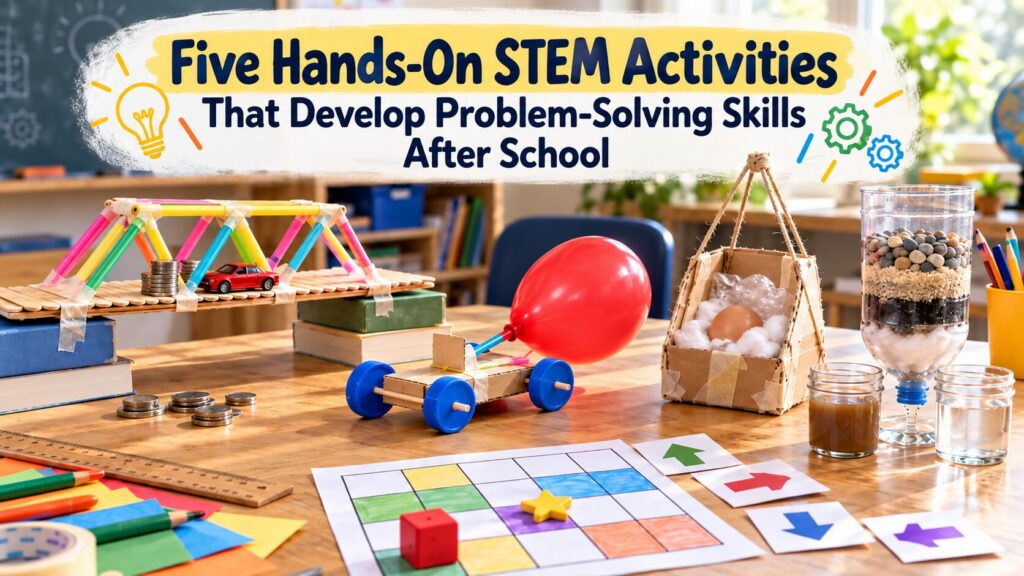
STEM activities combine science, technology, engineering and mathematics in practical ways. Instead of only reading instructions or memorising facts, children are encouraged to investigate a problem, test an idea and improve their solution.
Hands-on STEM activities are particularly suitable for after-school sessions because they make learning feel active and enjoyable. Children can work independently or as part of a group while developing creativity, patience, communication and logical thinking.
The following five hands-on STEM activities can be adapted for different ages and completed using affordable, easy-to-find materials.
Build a Bridge That Can Hold Weight
Children can use drinking straws, paper, wooden craft sticks, tape or building blocks to create a bridge between two surfaces. The finished structure is then tested by gradually adding coins, toy cars or other small objects.
The challenge encourages children to think about:
- How the weight will be distributed
- Which shapes create a stronger structure
- Where the bridge needs additional support
- Why one design performs better than another
If the bridge bends or collapses, children can examine what happened and modify their design. This helps them understand that an unsuccessful attempt is part of the learning process.
Older children can be given a limited number of materials or asked to build a bridge of a specific length. These constraints make the problem more challenging and require careful planning.
Create a Balloon-Powered Car
A balloon-powered car introduces children to movement, air pressure and basic engineering. It can be made using cardboard, bottle tops, straws, wooden skewers, tape and a balloon.
When the balloon is inflated and released, escaping air pushes the car forward. Children can test different designs to discover which one travels the furthest.
They may need to solve problems involving:
- Wheels that do not turn freely
- Axles that are not correctly aligned
- A car body that is too heavy
- Air escaping from the wrong place
- Uneven movement across the floor
Children can measure the distance travelled after each attempt and record the results. They can then change one part of the design at a time to understand which adjustment improves its performance.
Design a Protective Egg Container
In this engineering challenge, children must create a container that protects an egg when it is dropped from a safe, supervised height. A reusable plastic egg or another fragile object can be used where appropriate.
Materials might include paper, cardboard, cotton wool, string, tape and recyclable packaging. Before building, children should consider how their container will absorb the impact.
The activity develops problem-solving skills by asking children to:
- Predict what may happen during the drop
- Compare protective materials
- Create a secure structure
- Test their design safely
- Identify weaknesses and make improvements
Children can draw their idea before construction and explain why they chose particular materials. This encourages them to connect planning with the final result.
Appropriate supervision and a controlled testing area are essential when using real eggs.
Make a Water Filtration Model
A simple filtration model can help children explore how different materials remove visible particles from water. A cut plastic bottle may be layered with items such as gravel, sand, cotton wool and a coffee filter.
Children can pour muddy water through the model and observe how its appearance changes. The filtered water must never be consumed, as the activity does not make it safe to drink.
Before starting, children can predict which layer should come first and explain their reasoning. They can then compare different arrangements and observe which produces the clearest result.
This activity introduces several useful questions:
- Which materials capture larger particles?
- Why are several filtration layers helpful?
- Does changing the order affect the result?
- How could the design be improved?
It also creates an opportunity to discuss clean water, environmental responsibility and the difference between filtration and full water treatment.
Complete an Unplugged Coding Challenge
Coding skills can be introduced without using a computer or tablet. In an unplugged coding challenge, children create and follow a sequence of instructions to move through a grid or simple obstacle course.
Commands might include:
- Move forwards one space
- Turn left
- Turn right
- Pick up an object
- Repeat an action
One child can act as the programmer while another follows the commands. If the instructions do not lead to the correct destination, the group must locate the error and revise the sequence.
This process introduces algorithms and debugging in an accessible way. It also shows children why instructions must be precise and arranged in the correct order.
At Educate Leicester, hands-on STEM activities of this kind can complement homework support by giving children opportunities to apply classroom knowledge through practical challenges.
Frequently Asked Questions
What age groups can participate in hands-on STEM activities?
Hands-on STEM activities can be adapted for children across different age groups. Younger children may need simpler materials and more adult guidance, while older pupils can work with additional rules, measurements and design constraints.
What skills do STEM activities develop?
Practical STEM challenges can strengthen critical thinking, creativity, teamwork, communication, measurement and perseverance. They also teach children how to test ideas and learn from mistakes.
Do children need expensive STEM equipment?
No. Many effective hands-on STEM activities use cardboard, paper, tape, straws, bottles and other recyclable household materials. The value comes from the challenge and thinking process rather than the cost of the equipment.
Conclusion
Hands-on STEM activities give children a reason to ask questions, make predictions and test possible solutions. Building bridges, designing balloon-powered cars, protecting eggs, exploring filtration and completing coding challenges all turn learning into an active process.
When included in a structured after-school programme, these hands-on STEM activities can help children become more confident problem-solvers while making science, technology, engineering and mathematics engaging and relevant.